Published October 18, 2026 · Doorcount
A fourplex looks simple: four rents, one roof. That is exactly why buyers overpay for them. Conservative underwriting means you assume the building earns a little less and costs a little more than the listing says, then check whether the deal still works.
1. Start from today's rents, not "market" rents
Use what the four tenants pay now, from a rent roll and leases. Treat "market rent" or "rent upside" as a bonus you might find later, not money you pay for today.
2. Take a vacancy and unpaid-rent allowance
With only four units, one empty unit is 25% of your income. Budget for vacancy and unpaid rent even if the building is full today. Our free Multifamily Deal Check starts at 7%, and you can raise it for your market.
3. Re-assess the property taxes at your price
Many counties re-value a property when it sells. Estimate taxes as your purchase price times the county's effective rate, and use the higher of that or the seller's current bill.
4. Get a real insurance quote
Premiums vary widely by state and building. A quote from an agent beats any rule of thumb.
5. Set a floor for total operating costs
Small buildings often show low expenses because the owner does the work and skips repairs. Set a minimum expense ratio (total operating costs divided by income) by building age. The Deal Check uses 45% for buildings from 2000 on, 50% for 1970 to 1999, and 55% before 1970, and never lets costs fall below it.
6. Budget management even if you self-manage
Your time has a cost, and a lender or a future buyer will budget it. Include management as a percentage of collected income.
7. Add reserves for big-ticket items
Roofs, water heaters and HVAC wear out. Set aside a reserve per unit per year (the Deal Check suggests $250 to $300) so a replacement is not a surprise.
8. Test the loan with DSCR
Debt service coverage ratio (DSCR) is NOI divided by the yearly loan payments. Many lenders look for about 1.25x. Work backward: the payment your NOI can support at 1.25x tells you the loan, and the price, the property can carry.
A worked example (hypothetical numbers)
These numbers are made up to show the math. They are not market data.
| Line | Annual |
|---|---|
| 4 units × $1,200/mo current rent | $57,600 |
| Less 7% vacancy and unpaid rent | ($4,032) |
| Effective income | $53,568 |
| Operating costs at a 50% floor (1970–1999 building) | ($26,784) |
| Net operating income (NOI) | $26,784 |
| Most yearly debt service at 1.25x DSCR (NOI ÷ 1.25) | $21,427 |
| Loan that payment supports at 7.0%, 30 years | about $268,000 |
If the seller wants a price that needs a much bigger loan, the numbers say the price is too high or you need more cash. Change any assumption in the Multifamily Deal Check and watch the answer move.
9. Stress-test it
Ask what happens if a unit sits empty for three months, taxes reset higher, or the rate is a point higher. A deal that breaks under one of these needs a lower price or more cash.
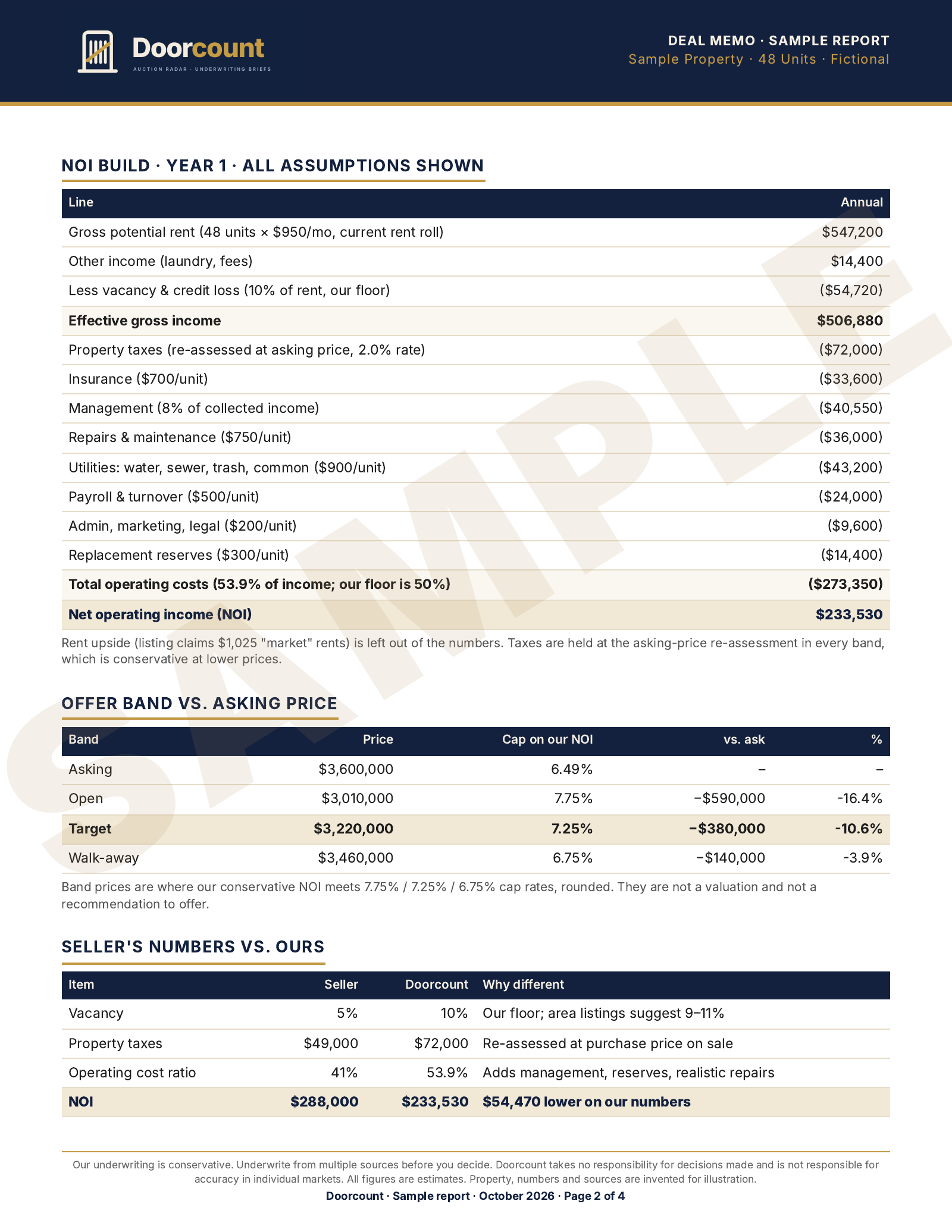
The Quick Check memo applies the same approach to one property and writes it up, with an offer band and financing options. See what's in a multifamily deal memo.
Please read. Our underwriting is conservative. Always underwrite from multiple sources before you decide. Doorcount takes no responsibility for your decisions and isn't responsible for accuracy in individual markets.